
Cancer Centre
Provide advanced, coordinated cancer care to patients across Johor, Singapore and the wider region.


Overview
At Regency Cancer Centre, our core objective is to provide advanced, coordinated cancer care to patients across Johor, Singapore and the wider region. Led by our panel of consultants across Clinical Oncology, Medical Oncology, Gynaecologic Oncology, Nuclear Medicine and Respiratory Medicine, the centre is further supported by a dedicated Cancer Nurse Navigator, oncology nurses, oncology pharmacists and allied health professionals.
Regency Cancer Centre is part of Regency Specialist Hospital, a 319-bed multidisciplinary hospital in Masai, Johor Bahru, serving over 200,000 patients a year with more than 80 specialists on staff.
Why Choose Regency Cancer Centre
- Sub-millimetre radiotherapy. Varian TrueBeam delivers image-guided radiotherapy with sub-millimetre accuracy, with many sessions completed in just a few minutes.
- Imaging and nuclear medicine, on-site. Siemens Somatom CT and FDG PET-CT staging, plus low-dose radioiodine capsule therapy, results flow straight into your treatment plan.
- 15 minutes from Singapore. Regency sits minutes from the Singapore–Woodlands checkpoint, putting advanced cancer care within easy reach.
- One roof, one care team. Radiology, laboratory, nuclear medicine, dietetics, rehabilitation and Traditional Chinese Medicine (REN TCM) all sit alongside oncology, nothing gets referred out.
- A Nurse Navigator, just for you. One dedicated Cancer Nurse Navigator coordinates your entire journey, a single point of contact from day one through survivorship.
- A spacious day care. 4 private beds and 14 reclining chairs, space for 18 patients at once, with free WiFi throughout.
Patient Journey
- 1Referral or self-referral to Regency Cancer Centre.
- 2First consultation, diagnostic work-up and staging.
- 3Multidisciplinary treatment planning.
- 4Treatment — surgery, radiotherapy, systemic therapy, or a combination.
- 5Follow-up, surveillance and survivorship support.
Becoming a Patient
Most patients arrive through a GP referral letter, a referral from another specialist, or by contacting us directly for a self-referral or second opinion. Your Cancer Nurse Navigator will confirm your appointment and let you know what to bring.
Preparing for Your First Appointment
- Review your patient packet. You'll receive a letter or packet of information explaining where to go and what to bring.
- Confirm your insurance or payment method. Contact your provider ahead of time, or call our billing desk at +607 381 7700 if self-paying.
- Gather your medical records. Bring pathology slides, prior scans, radiology films and relevant reports.
- Complete your paperwork in advance. Medication lists, patient history forms, or symptom questionnaires help your consultation run on time.
- Know where you're going. See "Planning Your Visit" below for directions and parking.
- Prepare your questions. See "Tips for Talking With Your Doctor" below.
Checklist for New Patients
1. Identification — NRIC or passport
2. Referral letter (GP or specialist), if you have one
3. Insurance card, corporate guarantee letter, or TPA details
4. Prior scans, radiology films, or pathology slides
5. Recent medical reports or discharge summaries
6. A current list of medications and dosages
7. Completed new-patient forms (sent to you in advance)
8. A list of your questions for the doctor
Tips for Talking With Your Doctor
- About your diagnosis: What type and stage of cancer do I have? What does that mean in practical terms?
- About your treatment options: What are my options, and what does each involve?
- About side effects: What should I expect, and how will they be managed?
- About your team: Who should I contact between visits?
- About daily life: Will I be able to work, travel, or care for my family during treatment?
Planning Your Visit
Location & directions. Regency Specialist Hospital is in Masai, Johor Bahru, and a short drive from Johor Bahru city centre.
Parking. On-site parking is available for outpatients and visitors; valet assistance can be arranged for patients with mobility needs.
Visiting hours. The Cancer Centre outpatient clinic operates Monday–Friday 8:00am–5:00pm and Saturday–Sunday 8:00am–12:00pm. Ward visiting hours and inpatient rules are shared at admission.
Where to stay. A short list of nearby accommodation is available on request. International and long-stay patients should see the International Patients section below for a fuller list and booking assistance.
The Breast Cancer Care Journey
An example of how a specific diagnosis moves through our care pathway, from screening to survivorship.
Who to screen — high-risk individuals (from age 30): family history of breast cancer, genetic mutation (e.g. BRCA1/BRCA2 gene), or history of chest radiation before age 30.
Who to screen — average-risk individuals (from age 40): individuals with signs or symptoms suggestive of breast malignancy should be referred early to a breast or surgical clinic for diagnostic evaluation, regardless of age.
1. Health Screening Centre. Clinical breast examination, mammogram, and breast ultrasound
2. Referral to Specialists. Diagnosis and treatment planning with a Breast Surgeon and Oncologist — tissue confirmation via biopsy, radiological staging (chest X-ray, CT scan, breast MRI, PET-CT), and lab tests
3. Clinical Care Programme Enrolment. Your case is coordinated by a multidisciplinary team, led by your Cancer Centre Case Manager / Nurse Navigator.
4. Cancer Treatment Modalities. Surgery (breast conserving surgery or mastectomy), breast reconstruction, systemic therapy (chemotherapy, hormonal therapy, targeted therapy, immunotherapy), and local radiation therapy.
5. Surveillance & Follow-Up Care. Continuous care and support for at least 5 years — physical examination, imaging and/or lab tests by your doctor, and regular breast self-examination by you.
Sources: Ministry of Health Malaysia; American Cancer Society.
For International Patients
Why Regency / Why Malaysia. Comparable technology — Varian TrueBeam, Siemens Somatom CT, and full Nuclear Medicine services — to major regional centres, at Malaysian private-hospital pricing. Access is 15 minutes from Woodlands, with no need to fly. Diagnostics, treatment, and allied health all sit under one roof, including a dedicated Cancer Nurse Navigator coordinating the whole journey.
Visa & Entry Requirements
Requirements vary by nationality, please confirm current requirements with the Malaysian High Commission or Embassy in your country before you travel.
1. Confirm your appointment with Regency
2. Receive your Doctor's Letter / hospital confirmation.
3. Submit documents for an Entry Approval Letter, where applicable, via the Malaysia Healthcare Travel Council (MHTC).
4. Travel, bringing your Doctor's Letter, passport, and any Entry Approval documentation.
Where applicable, MHTC's concierge arrival assistance can help expedite your arrival. Most patients travel with a family member or caregiver; companion visa requirements generally follow the same guidance as the patient's.
Cost & Package Transparency
Indicative ranges for treatment priced individually after consultation:
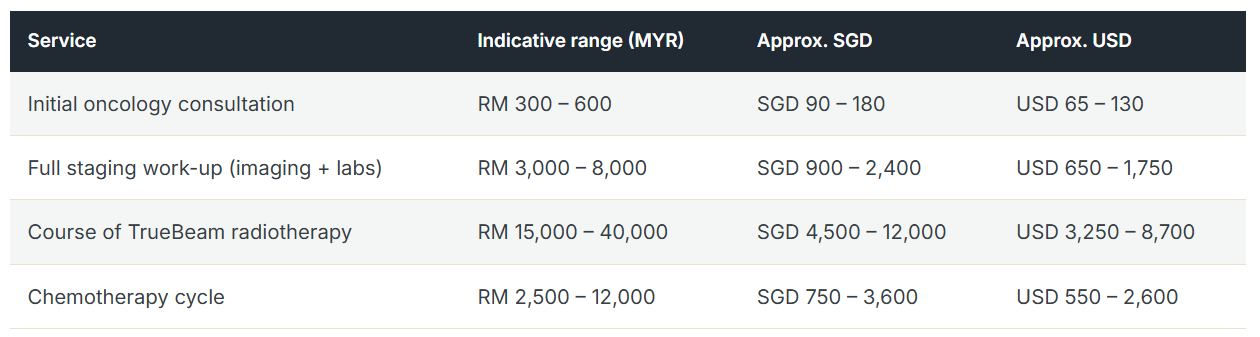
These ranges are indicative only, actual cost depends on cancer type, stage, and regimen. Request a written estimate after your first consultation.
Insurance & TPA Partners
Three common ways to pay for treatment: self-pay (a deposit is collected at admission, with itemised billing); international insurance (if your insurer or Third-Party Administrator has an arrangement with Regency, a Letter of Guarantee can often be arranged directly); and corporate guarantee (for patients referred through a corporate or government scheme). Accepted insurers and TPAs vary by plan, contact our billing desk to confirm coverage for your specific provider.
Concierge & Patient Journey Coordinator
Our concierge team, working alongside your Cancer Nurse Navigator, handles appointment scheduling, transfer coordination from the Woodlands checkpoint or Senai Airport, accommodation booking, interpreter booking, and discharge / travel-home planning. You keep the same Navigator as your single point of contact for the entire journey, not just the international-arrival stage.
Patient journey: Enquiry → Document submission → Entry approval → Arrival & transfer → Consultation & staging → Treatment → Recovery & travel home.
Language & Interpreter Services
Languages supported on-site or via interpreter: Bahasa Malaysia, English, Mandarin, Bahasa Indonesia, and Arabic. Let our concierge team know your preferred language when you book, so an interpreter can be arranged in advance. Halal food and prayer facilities are available on-site for patients and accompanying family.
Diagnosis & Treatment
Every patient at Regency Cancer Centre begins with a full diagnostic and staging work-up, so treatment decisions are based on a precise understanding of the cancer, not assumptions. Multidisciplinary input, combining oncology, radiotherapy, surgery and palliative support, shapes every recommendation we make.
Cancer Treatment
- Surgery. Tumour removal within our acute surgical facilities, supported by our Intensive Care Unit for complex cases.
- Chemotherapy. Delivered through our dedicated Chemotherapy Day Care — 4 private beds and 14 reclining chairs, with free wireless broadband and an on-site drug reconstitution room.
- Targeted Therapy. Guided by diagnostic findings from our laboratory and imaging teams.
- Immunotherapy. Helps a patient's own immune system recognise and fight cancer, or manage side effects.
- Hormone Therapy. Slows or stops hormone-driven cancers, such as certain breast and prostate cancers.
- Radiotherapy. Varian TrueBeam, planned on Siemens Somatom CT imaging — see Varian TrueBeam Technology below.
- Nuclear Medicine. FDG PET-CT metabolic imaging for staging, restaging and treatment-response assessment, alongside low-dose radioiodine capsule therapy for certain thyroid conditions.
- Scalp Cooling. Paxman scalp cooling during chemotherapy infusion, to reduce hair loss and support comfort and confidence through treatment.
Cancer Screening
- Breast Cancer. Mammography and clinical breast exam. High-risk individuals: screen from age 30. Average-risk: screen from age 40.
- Cervical Cancer. HPV testing and Pap smear, ages 21–65.
- Colorectal Cancer. Colonoscopy, sigmoidoscopy and stool-based tests, ages 50–75.
- Lung Cancer. Low-dose CT on our Siemens Somatom scanner, ages 45–75, current/former smokers.
- Prostate (PSA). Blood test — a raised PSA level guides further investigation.
- Nasopharyngeal (EBV DNA). Screens for early, asymptomatic nasopharyngeal cancer.
- Stomach (Gastroscopy). Camera examination of the food pipe, stomach and upper intestine.
- Multi-Cancer Early Detection. A single blood test screening for 10 aggressive cancer types at once — see Screening & Care Packages below.
Varian TrueBeam® Radiotherapy — Technology in Depth
Conventional radiotherapy delivers radiation to a planned target area. TrueBeam goes further: it images the tumour immediately before and during treatment, tracks motion in real time, and adjusts delivery accordingly — so the dose lands precisely where it's needed, session after session.
- Image-Guided Radiotherapy (IGRT). Built-in onboard imaging captures X-ray and cone-beam CT images immediately before treatment, so your care team can verify the tumour's exact position and adjust before each session begins.
- Intensity-Modulated Radiotherapy (IMRT). Shapes the radiation beam to match the exact contours of the tumour, sparing surrounding healthy tissue and organs.
- Volumetric Modulated Arc Therapy (VMAT). Delivers a full, precisely-shaped dose in one or two rotations — a key reason many TrueBeam sessions are completed in a matter of minutes.
- Stereotactic Capability (SRS / SBRT). For select cases, TrueBeam can deliver high-precision, high-dose stereotactic treatments in fewer sessions, where clinically appropriate.
- Real-Time Motion Management. Tracks natural patient movement — including breathing — during treatment, so the beam stays accurately aligned with a moving target such as a lung or liver tumour.
- Fast Dose Rate Delivery. High-output beam delivery shortens treatment time per session — less time on the table, without compromising precision.
Cancers we treat with TrueBeam: lung, breast, head & neck, prostate, liver, abdominal & pelvic, and select brain & spine cases. Suitability for stereotactic (SRS/SBRT) treatment depends on tumour type, size, and location — your radiation oncologist will confirm whether this approach applies to your case.
What to expect: (1) A planning CT scan on our Siemens Somatom scanner maps the tumour and surrounding anatomy. (2) Your radiation oncologist and medical physicist design a plan that shapes the dose precisely around the tumour. (3) Before each session, onboard imaging confirms your position, with adjustments made as needed. (4) The beam is delivered — often within a few minutes — while the system continues to track for movement. (5) Your care team reviews your progress throughout the course of treatment.
Lung Cancer Care
Small Cell Lung Cancer (SCLC)
Small cell lung cancer accounts for around 15% of lung cancer cases. It typically starts in the breathing tubes (bronchi) near the centre of the chest, grows quickly, and can spread early to the brain, liver, and bone.
Risk factors: smoking (now or in the past), secondhand smoke, asbestos or radon exposure. Symptoms: a cough that doesn't go away or coughing up blood; shortness of breath, wheezing, or persistent chest pain; hoarseness or swelling of the face and neck; unexplained weight loss, loss of appetite, or unusual tiredness.
Diagnosis: CT scan on our Siemens Somatom scanner, MRI where needed, and FDG PET-CT or bone scan to check for spread. A tissue or fluid biopsy — fine/core needle biopsy, bronchoscopy, or surgery — confirms the diagnosis. Staging is described as limited-stage (one lung, nearby tissue and lymph nodes only) or extensive-stage (spread beyond the originating lung).
Treatment: limited-stage disease is usually treated with chemotherapy and radiation to the chest; extensive-stage disease is usually treated with chemotherapy alone, to control the disease, extend life, and ease symptoms. A small number of very early-stage cases may be suitable for surgery. Because SCLC can spread to the brain regardless of stage, your care team may discuss whether additional treatment to reduce this risk is appropriate.
Non-Small Cell Lung Cancer (NSCLC)
NSCLC is the most common type of lung cancer, beginning when cells lining the lungs grow uncontrollably. It is generally more treatable when caught early.
Types: adenocarcinoma (the most common form), squamous cell carcinoma, and large cell carcinoma. Risk factors: smoking, secondhand smoke, prior chest radiation, asbestos/radon/industrial chemical exposure, air pollution, family history.
Diagnosis: CT and FDG PET-CT imaging, plus biopsy and genetic/biomarker testing (including for EGFR mutations — see below) to guide treatment. Staged I–IV based on tumour size, lymph node involvement, and spread: Stage I–II is often treatable with surgery; Stage III is locally advanced, usually treated with chemoradiation; Stage IV is advanced/metastatic, treated systemically.
Treatment by stage: early-stage (I–II) — surgery, sometimes with adjuvant chemotherapy; locally advanced (III) — chemotherapy and radiotherapy, sometimes surgery; advanced/metastatic (IV) — systemic therapy individualised to the tumour's genetic and biomarker profile, which may include a targeted oral therapy instead of, or alongside, chemotherapy.
EGFR-Mutant Lung Cancer
The epidermal growth factor receptor (EGFR) helps tell cells when to grow. In some non-small cell lung cancers, a mutation in the EGFR gene causes this protein to stay switched on, driving uncontrolled cell growth.
Why this matters in our region: EGFR mutations are found in around 15% of lung cancer patients in the United States and Europe — but in roughly half of lung cancer patients across Asia. Genetic testing for this mutation is a routine and important part of diagnosing non-small cell lung cancer for our patients.
EGFR status is checked as part of genetic and biomarker testing during NSCLC diagnosis, usually from a tissue biopsy, and in some cases a blood ("liquid biopsy") test. Early-stage disease may still be treated with surgery; for advanced or metastatic EGFR-mutant disease, an oral targeted therapy (an EGFR inhibitor) is often used first, instead of standard chemotherapy. Over time, tumours can develop resistance to targeted therapy — a repeat biopsy or blood test can help identify the change and guide the next treatment step. Our oncology pharmacists support patients in managing oral targeted therapy, including dosing and side-effect management.
Screening & Care Packages
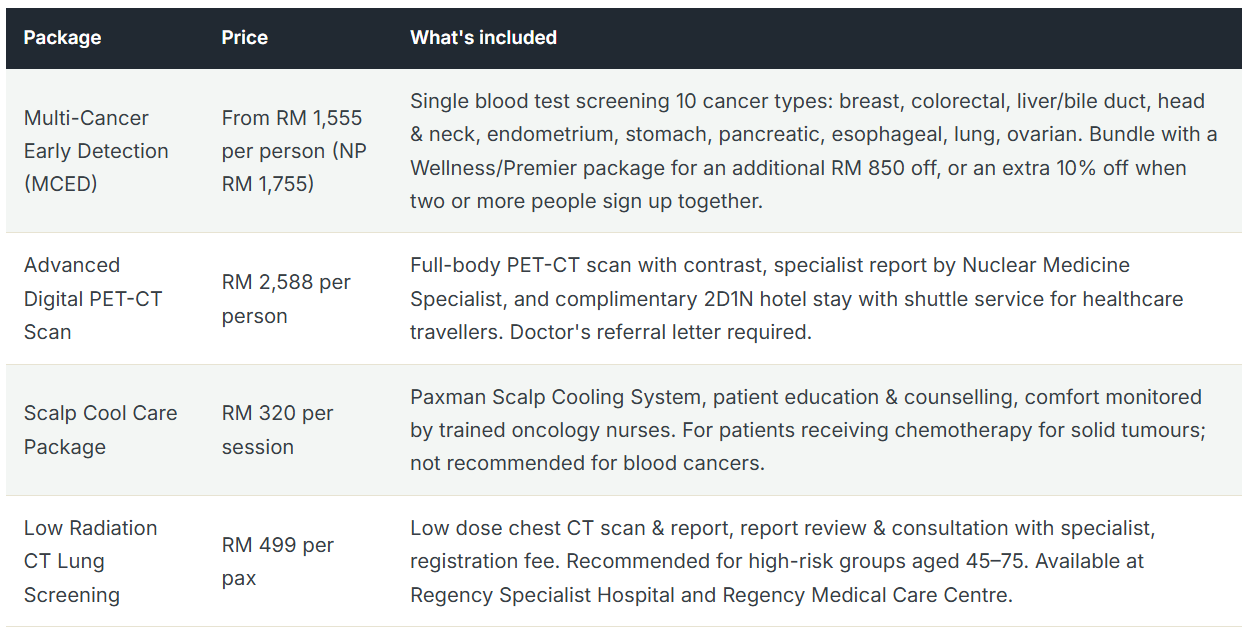
MCED valid per current promotion terms; PET-CT package available until 31 December 2026; Scalp Cool Care package valid until 31 December 2027; Low Radiation CT Lung Screening promotion valid until 31 December 2026 (KKLIU 4103 / 31.12.2027). Regency Specialist Hospital Sdn Bhd reserves the right to revise package rates at any time. Printable flyers for each package are available on request from our Careline.
Comprehensive Care Plan
Your Cancer Nurse Navigator
Every patient at Regency Cancer Centre is assigned a dedicated Cancer Nurse Navigator from their very first visit, providing end-to-end support and a single point of contact throughout diagnosis, treatment, recovery and survivorship. The Navigator coordinates appointments and treatment scheduling, liaises between specialists, and helps you find the right care at every stage, so you and your family always know who to call and what happens next.
Our Multidisciplinary Care Team
Every patient's care is guided by a Clinical Care Programme drawing on specialists and allied health professionals across disciplines, coordinated by your Cancer Centre Case Manager / Nurse Navigator.
- Registered Medical Practitioners: General / Breast Surgeon, Oncologist, Plastic Surgeon, Radiologist, Nuclear Medicine Physician, Pathologist, Psychiatrist
- Oncology Nursing Professionals: Cancer Centre Case Manager / Nurse Navigator, Oncology Nurses
- Allied Healthcare Professionals: Oncology Pharmacists, Dietitians & Nutritionists, Rehabilitation, Patient Support Group
Cancer Survivorship
Life after active treatment brings its own questions. The same Cancer Nurse Navigator who coordinated your treatment continues to support you afterward, helping you understand what follow-up care you need, connecting you with the right specialists, and answering questions as they come up.
Depending on your diagnosis and treatment, your Navigator can help connect you with specialists across Regency, including:
- Cardiologists — to monitor and manage any heart-related effects sometimes associated with cancer treatment.
- Endocrinologists — for issues related to the thyroid, adrenal glands, and other hormonal effects of treatment.
- Oncology Rehabilitation — through our Rehabilitation Department, to help rebuild strength, mobility, and stamina after treatment.
- Gynaecologists — for fertility and women's health concerns following treatment.
- Nephrologists — for monitoring and managing kidney-related effects of treatment.
- Nutrition Counselling — to help rebuild healthy eating habits and manage any ongoing dietary needs.
Community & Peer Support
Regency partners with The Breast Cancer Support Group JB, a non-governmental organisation providing peer support to breast cancer survivors and patients, and raising public awareness in Johor Bahru. Many of our patients find it helpful to connect with others who understand what they're going through. Visit The Breast Cancer Support Group JB on Facebook.
Breast Self-Examination (BSE)
Know your body. Detect changes early. When to check: once a month, 7–10 days after the first day of your period. If your periods are irregular or you no longer have them, choose a fixed day each month.
Look & feel for changes: a lump in the breast or armpit; changes in size or shape; dimpling, skin texture and colour changes; unusual or bloody nipple discharge; pain or tenderness.
How to check: (1) Look in the mirror — arms at your sides, hands on hips pressing firmly, then arms raised above your head, checking for changes. (2) Feel your breast lying down — pillow under your shoulder, arm behind your head, feeling the breast, nipple and armpit with your index, middle and ring fingers in small circular motions, covering top to bottom, side to side, from collarbone to under your bra line, and inwards to your armpit. (3) Feel your breast standing — raise your arm above your head and repeat the same technique. You may check in the shower — soapy skin helps your fingers glide smoothly.
Know what's normal for you, and consult a doctor if you notice any changes.
Specialist Doctors
Listed alphabetically within each specialty.
Clinical & Medical Oncology


Gynaecologic Oncology

Respiratory Medicine — Lung Cancer

Schedule an Appointment
Careline
- WhatsApp (only): +6016-722 7288
- Phone: +607-381 7700
- Emergency Hotline: 1800 222 505
- General enquiries: contactus@regencyspecialist.com
- International patients / teleservices: rsh_teleservices@regencyspecialist.com
Our Locations
Regency Specialist Hospital
No. 1, Jalan Suria, Bandar Seri Alam, 81750 Masai, Johor, Malaysia
Regency Medical Care Centre
The Mall, Mid Valley Southkey (Ground Floor, North Entrance)
Whether you need a second opinion, a full diagnostic work-up, or are ready to begin treatment, our Cancer Nurse Navigator can help you find the right specialist and coordinate every step from your first appointment onward. Call, WhatsApp, or email us using the details above, or book directly with a specialist listed under Specialist Doctors.
Have question?
Get in touch with RegencyCentres of excellence
Centres of Excellence available in Regency Specialist Hospital
Deliver high quality maternity care throughout pregnancy, birth and postnatal period.

Work with medical experts from all disciplines to diagnose, treat and manage your diabetes.

Provides a full range of diagnostic and therapeutic treatments for all types of digestive diseases.

Operates 24 hours a day and is one of the state’s busiest private emergency departments.

Provides comprehensive preventive, diagnostic, therapeutic and rehabilitative heart and lung services.

Leading neuroscience and neurospine care at Regency Specialist Hospital in Johor Bahru. Advanced diagnosis, tr ...

Deliver high quality maternity care throughout pregnancy, birth and postnatal period.
Work with medical experts from all disciplines to diagnose, treat and manage your diabetes.